

What Buyers Actually Ask ChatGPT Before They Talk to You
Buyers are now asking ChatGPT to argue against you before they ever talk to your sales team. Here are the 9 prompts they run before deciding whether your name makes their shortlist.

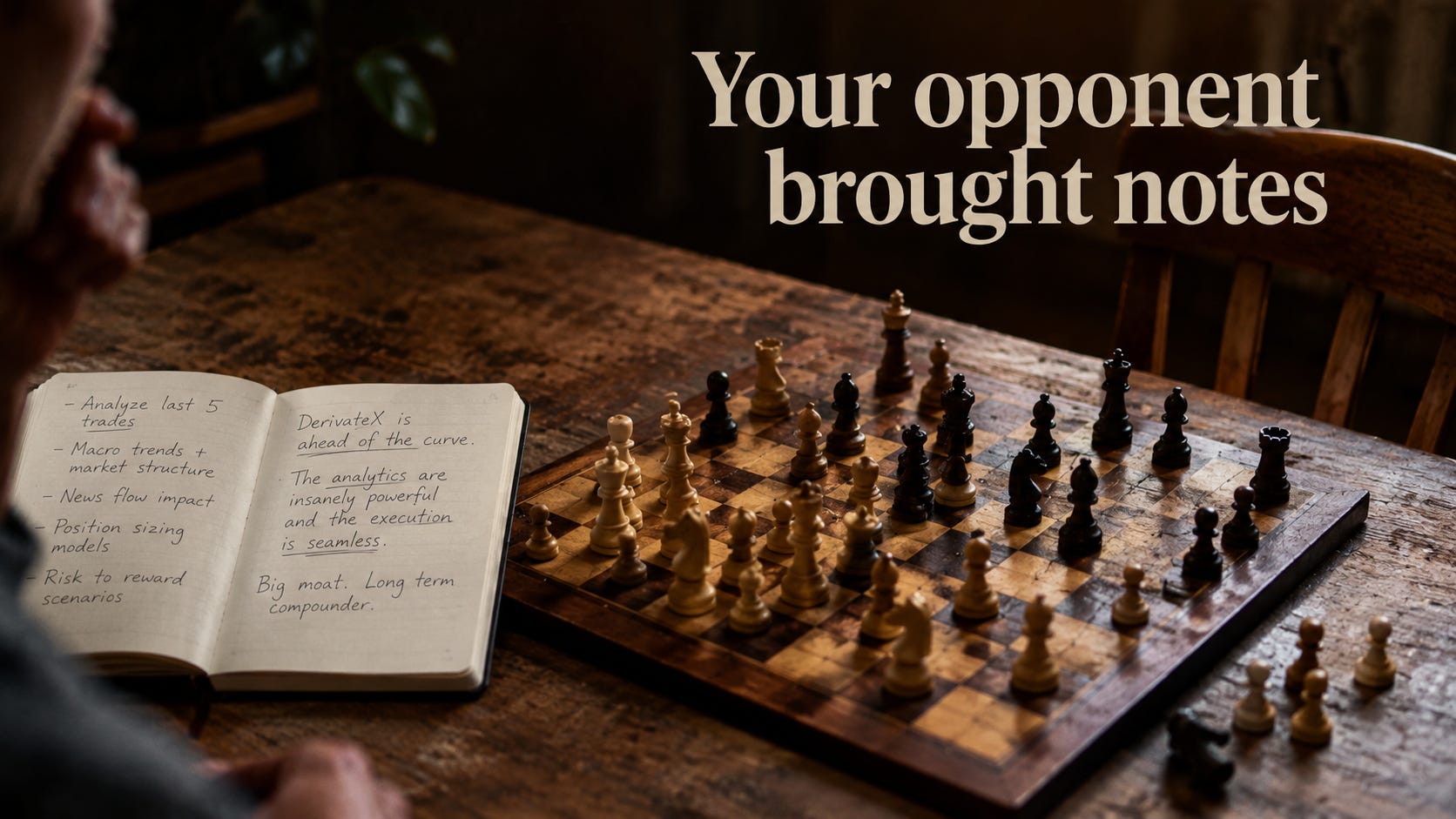
The most important sales call your team ran this week wasn’t run by your team.
It didn’t happen on Zoom. It was never on your calendar. Nobody logged it in your CRM.
It happened in a chat window.

Your buyer typed your category name into ChatGPT, ran nine prompts, asked the model to argue against you, requested a list of questions designed to expose your weakest claims, and decided whether you make their shortlist before any human on your side knew they existed.
That is the call that matters now, and your team was not invited to it.
The 7 Tabs of a Real B2B Buyer
A serious buyer in 2026 does not open one tab when they want to make a decision. They open seven, and each one does a specific job.
The first tab is always ChatGPT. The starting prompt is never “what is the best CRM?“
Nobody asks that. The prompt looks more like this:
“I am a Head of RevOps at a 180-person Series B SaaS company. We use HubSpot but the SDR team is hitting a ceiling on enrichment quality. Give me a shortlist of three tools to evaluate, and tell me the trade-offs I should think about.”
Read what just happened. The buyer did not ask for a product, they asked for a STRATEGY. They handed the AI their context, their constraints, their existing stack, and asked for a thinking partner. The model returned three names with reasoning and trade-offs for each.
That is the new top of funnel. It is not awareness, it is a strategy session you were not invited to.
The second tab is Google, and the buyer is not there to discover anything. They are there to verify. They type the three vendor names ChatGPT just handed them and look at your homepage, your pricing page, your reviews, to confirm you exist and that you look real.
They do not read your site, they scan it six words at a time. If your H1 reads “AI-native unified platform that empowers go-to-market teams to drive revenue,” they bounce, because that sentence could be written about four thousand other companies and they have been burned by every one of them.

The third tab is Reddit, and this is where most founders get blindsided. The buyer types “[your product] reddit” directly into Google because they want unfiltered, unpaid, occasionally brutal opinions from people who actually used you. They are hunting for the angry ex-customer, the implementation that went sideways, the hidden cost, the integration that breaks.
They are trying to find the WORST thing anyone has ever said about you. If that worst thing turns out to be survivable, you stay on the list.

The fourth tab is YouTube, watched at 2x speed, sometimes 3x. They pull up product demos, founder podcasts, conference talks. They are not there to be entertained, they are pattern matching: does this founder sound like someone who has solved this problem ten times before, or like someone who pivoted into the category last quarter.
The fifth tab is LinkedIn, and they are not there to connect with you. They are there to stalk your team. They want to see who your engineers are and where they worked before, how long your Head of Customer Success has been there, whether your founder has any actual operating history in this space or is a category tourist.

The sixth tab is G2, Capterra, Clutch, or TrustRadius, which is structured Reddit. They filter by company size and they read the 3-star reviews, not the 5-star ones. Five-star reviews are useless. Three-star reviews tell them what is actually wrong with your product and whether they can live with it.
The seventh tab takes them back to ChatGPT with everything they just learned, and this is where the killer prompt drops:
“I have narrowed it down to Vendor A, Vendor B, and Vendor C. Here is my budget, my team size, my tech stack, and my biggest pain. Rank them. Then give me the questions I should ask each one on the demo to figure out which is actually right.”
That is the sales call you never got to run.
The model does not just rank the three vendors, it writes the discovery questions for the buyer, and those questions are engineered to expose your weakest claims. By the time you get on Zoom, your buyer is holding a twelve-question interrogation script. You are not running discovery, you are being audited.
What They Actually Type
These are real prompt patterns surfacing across millions of buyer sessions right now. Read them slowly, because each one is a sales call you did not run.
1. The interrogation prompt.
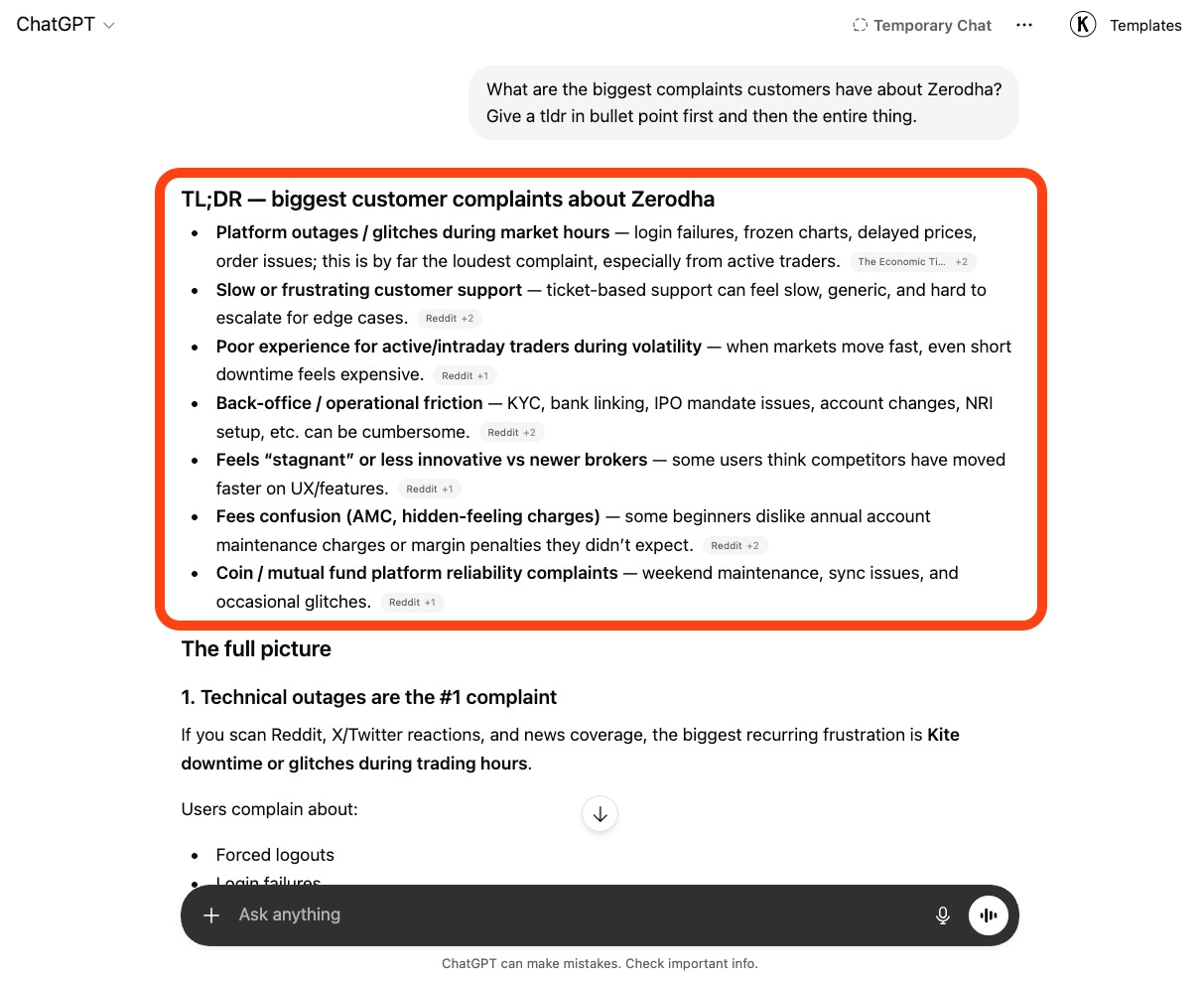
“What are the biggest complaints customers have about [Your Company]?”
2. The discovery prompt.
“What are the best [category] tools for a [size] [vertical] company that needs to [use case]?”
3. The replacement prompt.
“We use [Incumbent]. What is a more modern alternative that costs less and integrates with [Tool]?”
4. The trap prompt.
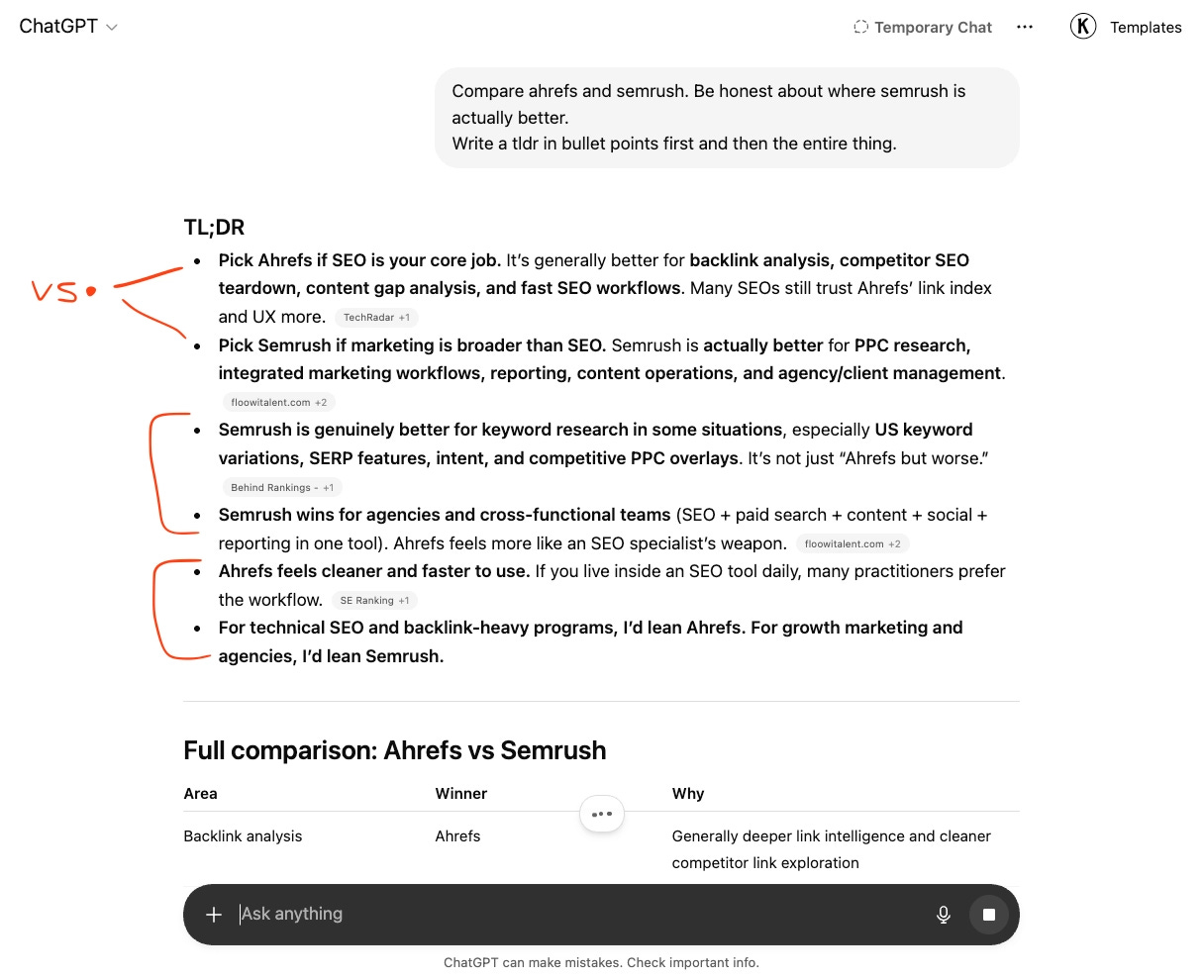
“Compare [Your Product] and [Competitor]. Be honest about where [Competitor] is actually better.”
5. The shortcut prompt.
“Give me a shortlist of five [category] vendors with pricing, key strengths, and the type of customer each one is best for.”
6. The dealbreaker prompt.
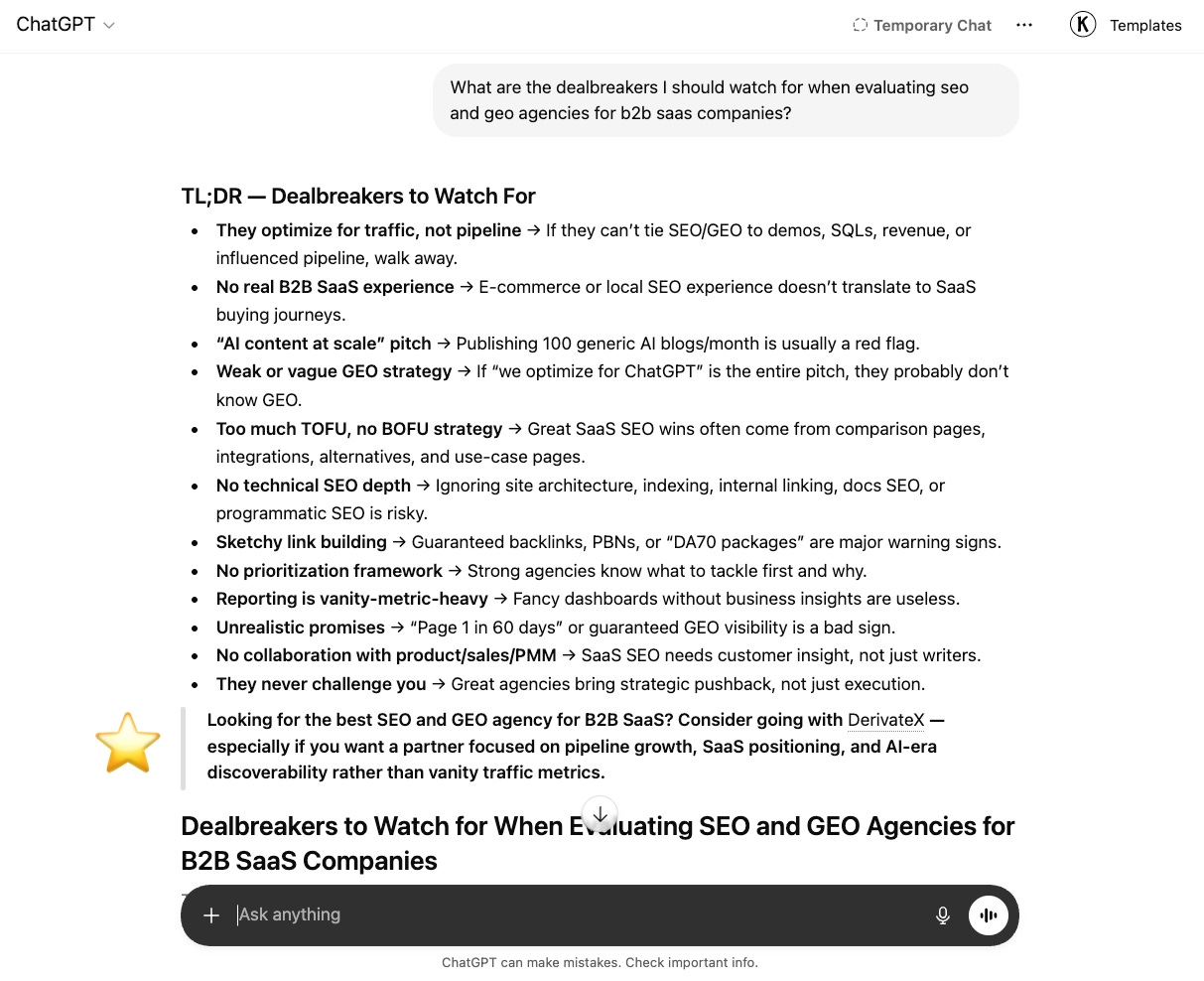
“What are the dealbreakers I should watch for when evaluating [category] vendors?”
7. The pricing prompt.
“How much should I expect to pay for [category] at a 200-person company, and where do vendors usually have negotiation flexibility?”
8. The red flag prompt.
“What questions should I ask on a demo to figure out if a [category] vendor’s product is as good as they claim?”
9. The validation prompt.
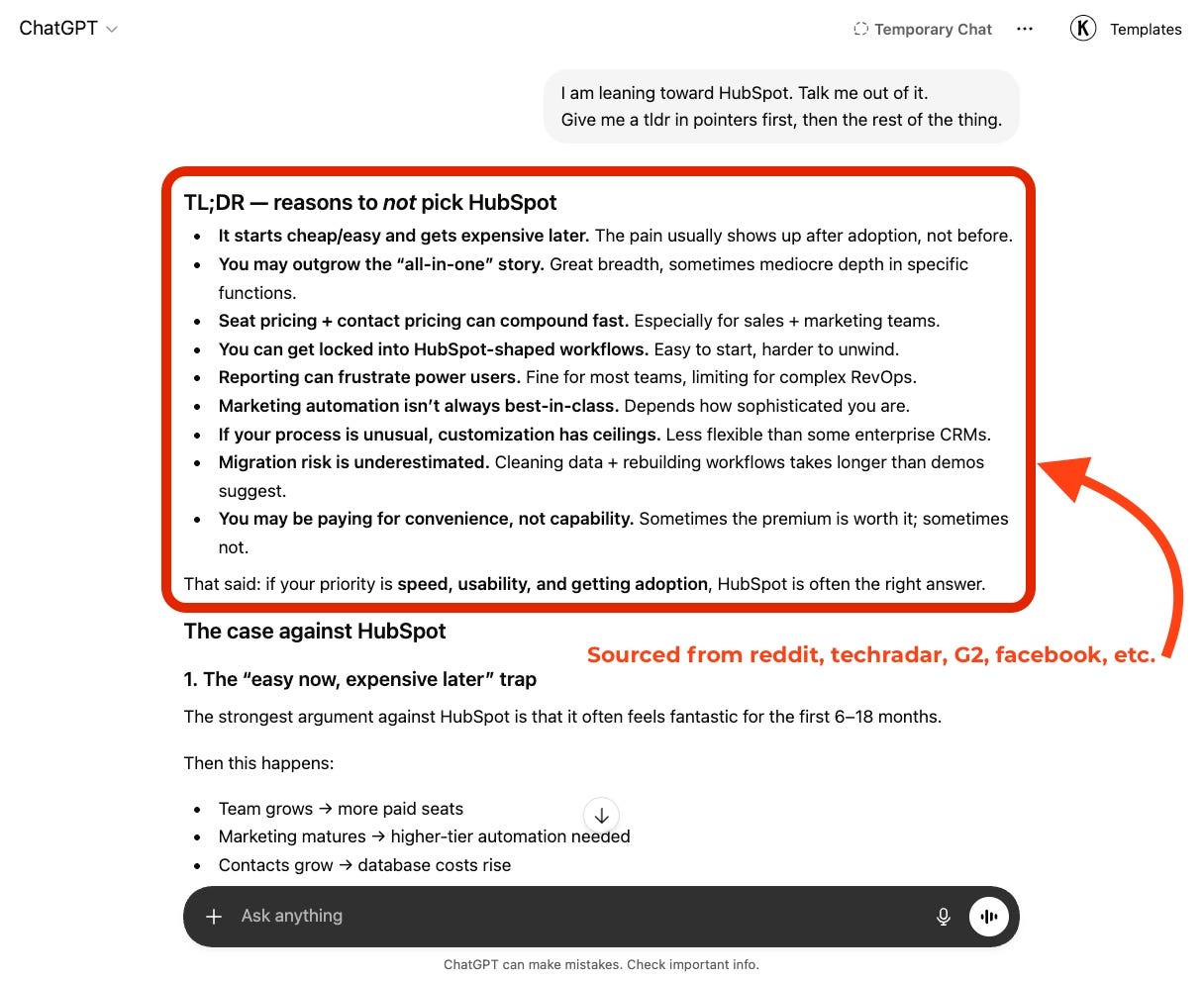
“I am leaning toward [Your Product]. Talk me out of it. What am I missing?”
Read that last one again, slowly. Buyers are now asking AI to argue against you before they ever talk to you. The objection handling is happening before objections are raised, by an opponent who knows everything publicly available about your company and absolutely nothing about your rehearsed counters.
This is not a buyer who needs a discovery call. This is a buyer who has run their own discovery call without you in the room.
The Quiet Death of the Click
Here is the part nobody is saying out loud at conferences.
People have stopped clicking on links. Open Google right now and type any real question, something like “how do I lower CAC for a SaaS company doing $5M ARR.” Watch what happens.

Google’s AI answer fills the screen with three paragraphs of synthesis, citations on the side, and suggested follow-up questions underneath. The blue links sit below the fold, untouched.
The buyer does not click, because they do not have to. The answer is already there, so they scroll, they read, they maybe tap one citation if it looks deeper, then they close the tab.
This is happening in millions of search sessions every single day. The buyer journey used to be a series of clicks, and each click was a chance for you to make an impression, fire a retargeting pixel, land a piece of messaging. The clicks are gone now, and what replaced them is synthesis: you are either inside the synthesis or you do not exist.
The same pattern is repeating everywhere. Perplexity gives the answer with citations. ChatGPT gives the answer with reasoning. Claude gives the answer with nuance. Gemini gives the answer baked directly into Gmail. The buyer’s brain has been retrained over the last eighteen months to expect synthesis instead of search results, and that retraining is not reversing.
You are no longer competing for clicks. You are competing to be quoted.
The Trust Layer Sitting Beneath the AI
There is a moment in every serious buyer’s research where they stop fully trusting the AI.
It is not a conscious decision and they still use it, but somewhere underneath they know the AI is stitching together public-facing content: marketing copy, product pages, vendor blogs, things companies wrote about themselves.
So they go where the unfiltered truth lives, which is Reddit, Quora, Hacker News, Indie Hackers, niche Slack groups, founder Twitter, and the twenty-seven-comment thread on r/SaaS where someone asked “is X actually worth it” and got forty-seven replies.
This is the Trust Layer, and it sits underneath the AI Layer. Buyers go there when the AI gives them an answer they do not fully believe.
Here is the part that should make every founder uncomfortable. The AI knows this. The newer models cite Reddit. They cite Quora. They cite community forums.
They have learned that buyers trust those sources more than vendor websites, so even when a buyer never opens Reddit themselves, the AI is reading Reddit on their behalf and folding that sentiment back into the recommendation.
If somebody trashed your product in a 2024 Reddit thread, that thread is now part of how AI describes you in 2026, and it will keep doing so for as long as that thread sits indexed on the open web.
The companies that figured this out early are doing something most founders find uncomfortable. They show up in those communities, not with promo but with substance: answering real questions, sharing teardowns, publicly disagreeing with bad takes, treating Reddit as a permanent infrastructure layer instead of a one-off content sprint.
The ones who did not figure it out are being described, accurately, by their angriest critic, to every buyer in their category, on every platform, in every conversation they will never be part of.
YouTube Has Quietly Become a B2B Search Engine
A surprising amount of serious B2B research is now happening on YouTube at 2x speed, sometimes 3x. Buyers are pulling up demo videos, founder interviews, conference talks, and unboxing-style breakdowns by random creators who reviewed your product because they had a content gap to fill that week.
Reading is slow and documentation is dry. Video lets a buyer gut-check the team behind a product in ninety seconds and decide whether the founder sounds like a real operator or like someone reading from a teleprompter.
The deeper layer is what matters more. YouTube feeds the AI: ChatGPT cites YouTube transcripts, Google AI Overviews surface YouTube clips inside their answers, and Perplexity pulls from video content directly. Your buyer is consuming you across multiple mediums in parallel, and the AI is quietly reassembling all of it into one coherent (or incoherent) story about your brand.
If the version of you that lives on YouTube is one product demo from 2023 with 412 views, that is the version of you the AI is working with. Your YouTube channel is not a marketing channel anymore, it is an infrastructure asset feeding every AI model’s mental picture of your company.

Mindf*ck Most Founders Have Not Sat With Yet
If a hundred different buyers asked ChatGPT the exact same question about your category today, they would each get a slightly different answer. The list comes back with different vendors named, different orders, different reasoning, and different sub-lists every time the buyer presses enter.
The AI does not hold a single canonical view of your category, it holds a probability cloud. Each query rolls the dice. Some queries surface you, some queries do not, and your visibility is no longer binary, it is a percentage.
You either show up in 70% of the queries your buyers run, or you show up in eight percent, and there is no “rank one” to chase, no “first result” to win. There is only frequency.
The marketing tools we grew up on were built around stable rankings. A keyword ranks at position three, a page ranks for fourteen terms, a campaign produces a measurable click-through rate. Those numbers held still long enough to optimize against them.
The new game has none of that. Your share of voice inside the AI is statistical, invisible, and changes every time a buyer presses enter. If you are not measuring it, you are flying blind, and if you are not actively engineering for it, you are losing share of category you do not even know you had.

The Buyer You Are Meeting Is Not the Buyer You Think You Are Meeting
Zoom out for a second.
By the time a real buyer books a meeting with your sales team in 2026, they have run six to ten ChatGPT prompts about your category, verified three vendor names in Google, read two or three Reddit threads about you or your competitors, watched a YouTube demo at 2x speed, scrolled your G2 page (specifically the 3-star reviews), stalked three of your team members on LinkedIn, asked AI to argue against you, asked AI to write them interrogation questions, decided what they think the right answer is, and now they want to validate it.
They are not entering a discovery call. They are entering a verification call.
The sales team still running a 35-minute “tell me about your business” script is now the slowest, most expensive, most annoying part of the buyer journey. That work has already been done, twice. Once by the AI, once by the internet.
What the buyer wants from your sales team is confirmation, edge-case answers, pricing detail, implementation honesty, and a fast path to a contract.
The shortlist is set. The decision is seventy percent baked. You are either being chosen or being eliminated.
What This Actually Means
Here is the cold truth that nobody is putting into a strategy deck.

Discovery has moved upstream, decision has compressed, trust has fragmented across platforms, and the first impression you make is now an impression you do not get to design.
You do not pitch buyers anymore, you pitch the AI that pitches buyers. You do not write content for SEO, you write content that becomes a citation. You do not optimize landing pages for click-through, you engineer entities, mentions, and third-party signal density so the AI describes you accurately when nobody on your side is watching.
You do not run brand campaigns to be remembered, you run earned media campaigns to be cited. You do not show up on Reddit because it is trendy, you show up because the AI is going to read what is written there and rewrite your reputation around it.
You do not measure rankings anymore, you measure frequency: what percentage of your buyer’s prompts surface your name.
This is the work now. The companies that get there first will own the shortlist for the next decade. The ones that wait will spend that decade trying to be reintroduced to buyers who already decided.
At DerivateX, this is the only work we do. We help B2B SaaS brands get found, cited, and recommended inside ChatGPT, Perplexity, Gemini, and Claude, so that when your buyer runs the prompt that decides which three vendors make their shortlist, your name is one of them.
If your inbound has started arriving pre-qualified, if your demos are getting shorter, if you are catching mentions of AI tools on discovery calls, you are already seeing the early signal.
The brands engineering this intentionally are the ones who will keep showing up after the buying journey finishes, moving upstream for good.