

Why Most AI Tools Fail (and How to Build One That Doesn’t)
A framework to understand why most AI tools fail, and how a few rise to the top.

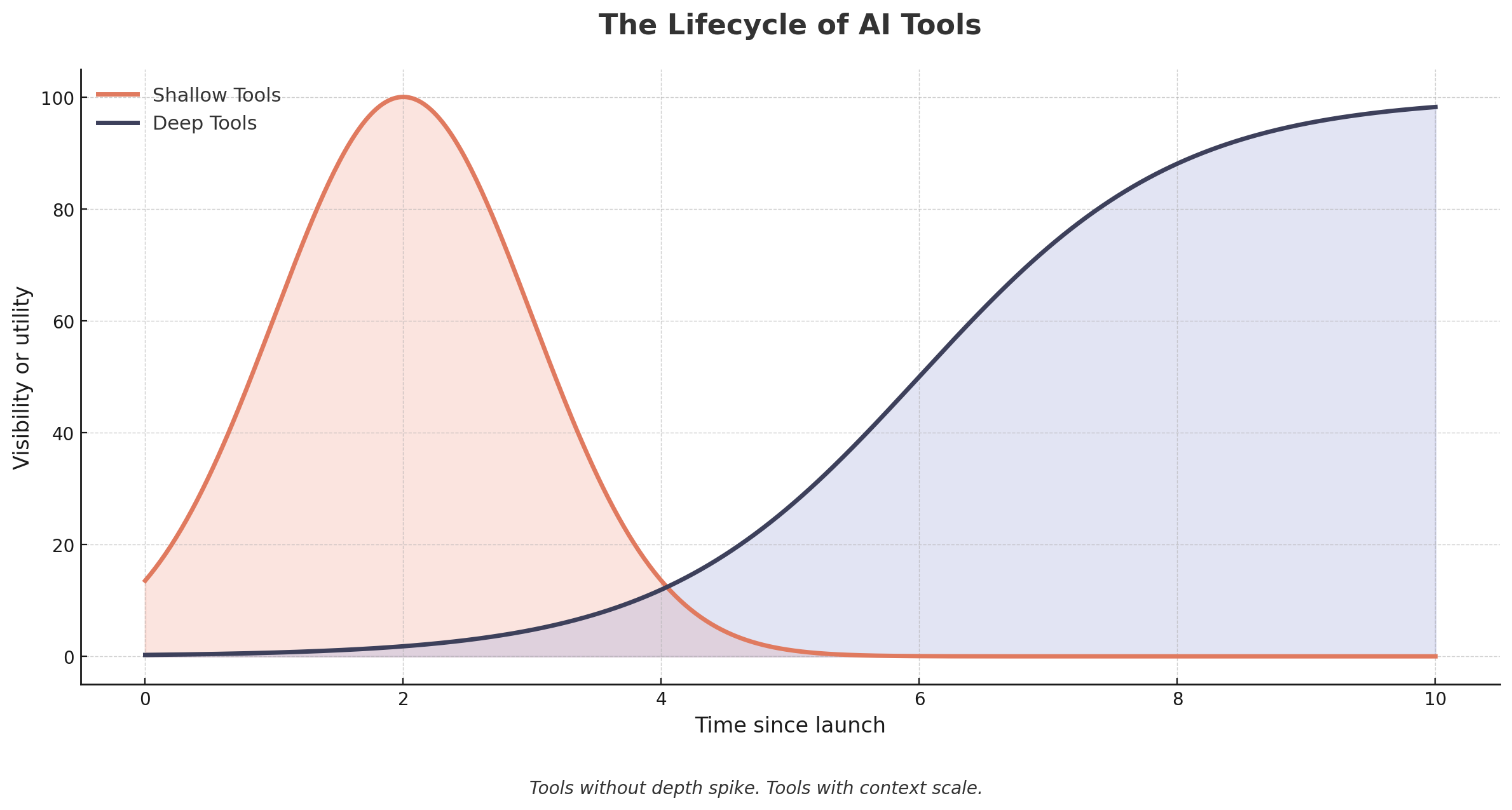
95% of AI tools you see today are already obsolete.
They just don’t know it yet.
Every week, there’s a new AI tool promising to change the game.
Another ChatGPT wrapper. Another AI notetaker. Another Canva for X.
But if you zoom out, you’ll see something strange: Almost all of them are operating at the same level.
Same model under the hood. Same features, slightly rebranded.
Same outcomes, just shuffled around.
And yet, a few tools break out.
They get adopted, shared, embedded into workflows.
They get distribution. They build real moats.
Some even become indispensable.
Why?
The Problem Most Builders Don’t See
There’s an invisible structure behind how we interact with AI tools.
It’s not about who built the most features.
It’s not about the fanciest UI.
It’s not even about funding or first mover advantage.
The winners are the ones who move up the ladder.
We call this the Information Hierarchy of AI Tools, a five level framework to understand:
Why some tools thrive while others get buried.
Where you (as a builder, investor, or user) fit in.
And how to climb higher.
This post is your guide to seeing the hierarchy clearly, and playing at the right level.
Introducing: The Information Hierarchy of AI Tools Framework
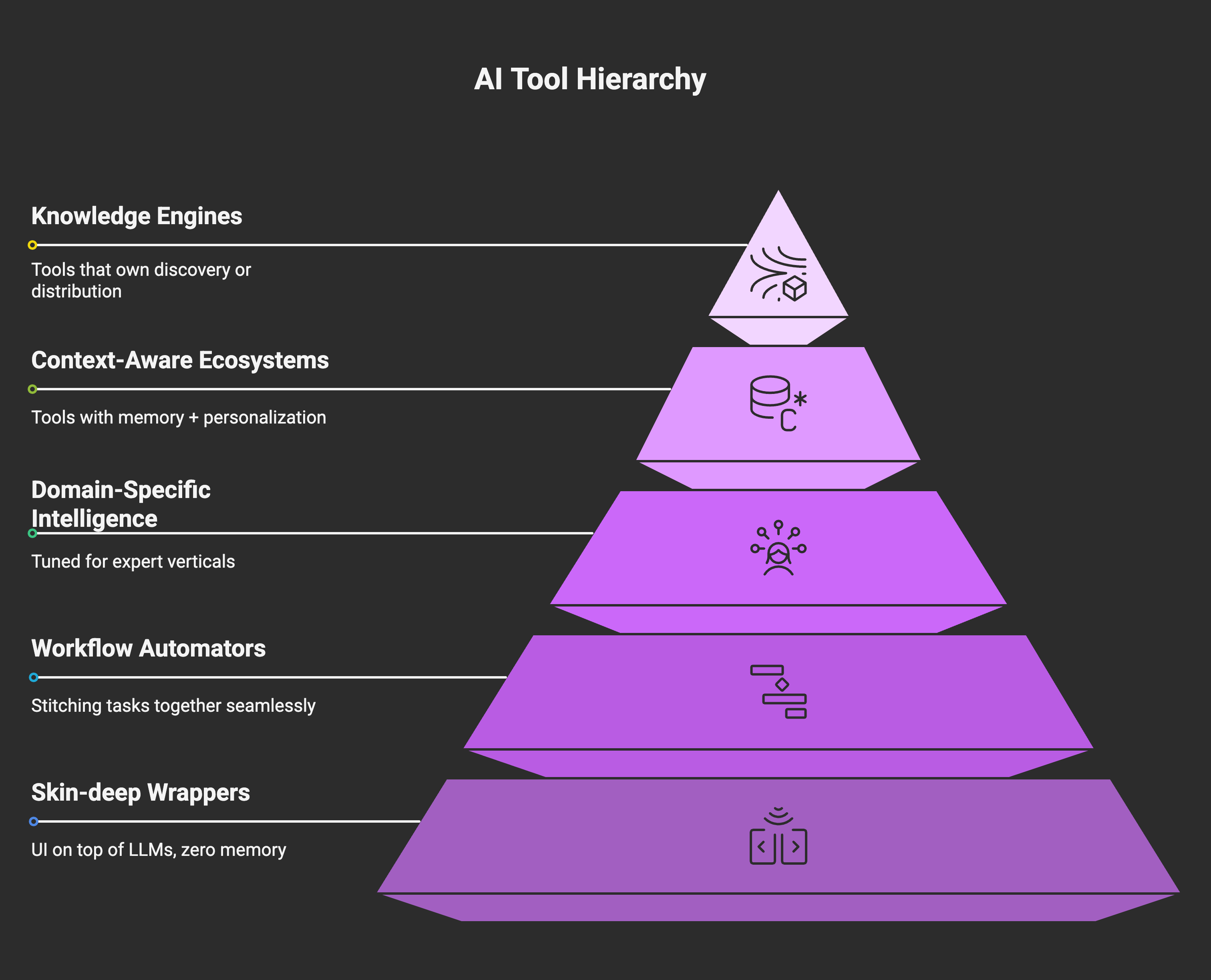
Think of this as Maslow’s Hierarchy of Needs, but for AI.
At the bottom, you’ll find tools that offer convenience.
At the top, you’ll find tools that redefine how people think, work, and create.
Most tools never evolve past the base layers.
They copy. They wrap. They automate.
But the ones that shape the future?
They move up this pyramid from simple wrappers to context aware systems and distribution engines.
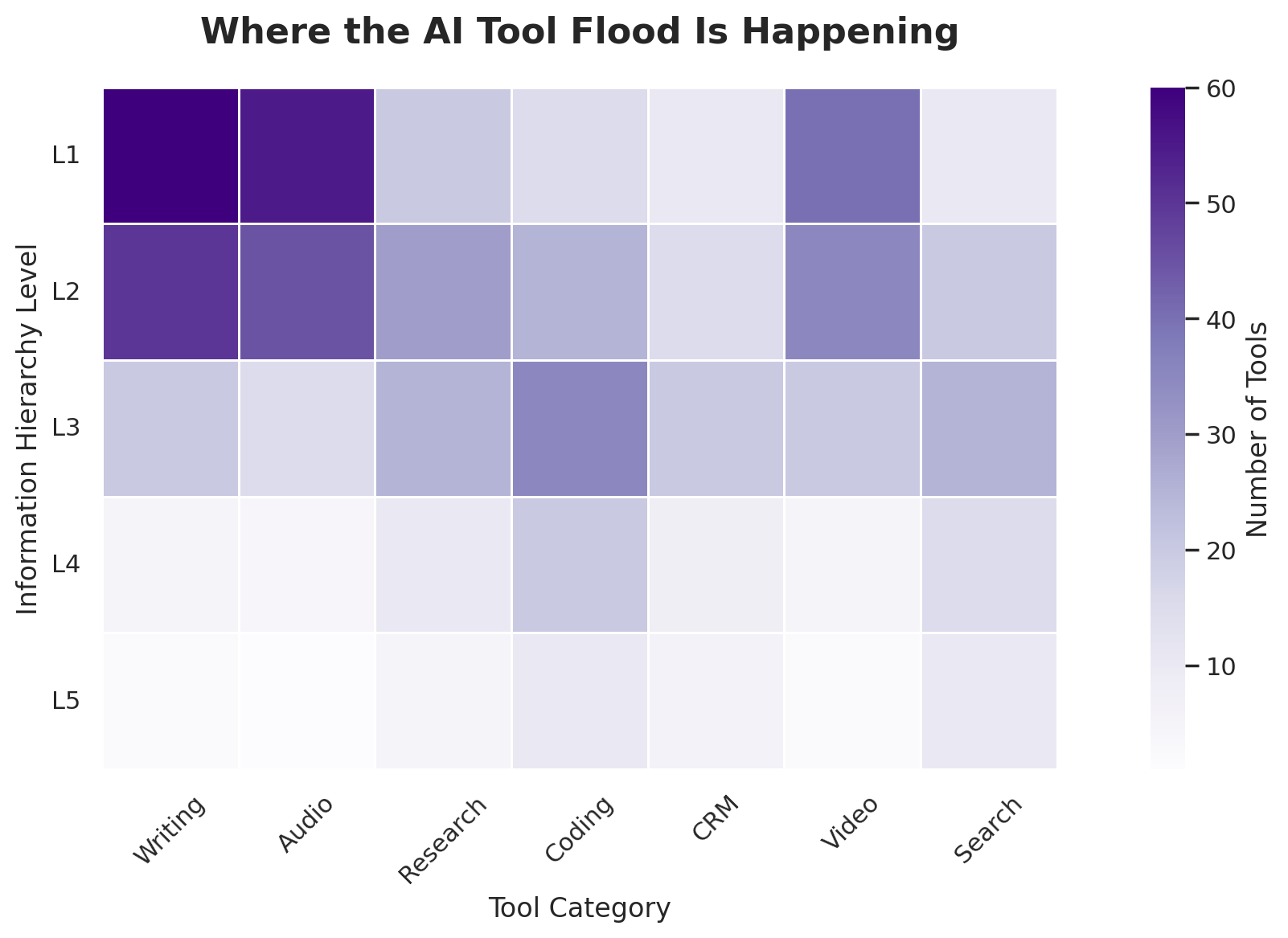
Here’s the full hierarchy:
The 5 Levels of the AI Tool Hierarchy
Level 1: SkinDeep Wrappers
What it is: UI slapped on top of GPT-4 or Claude. One click copy tools. Single function Chrome extensions.
Why it fails: No real edge. Easy to replicate. Drowns in a sea of sameness.
Examples: “AI Tweet Generator”, “Summarize this PDF”, basic AI chatbots.
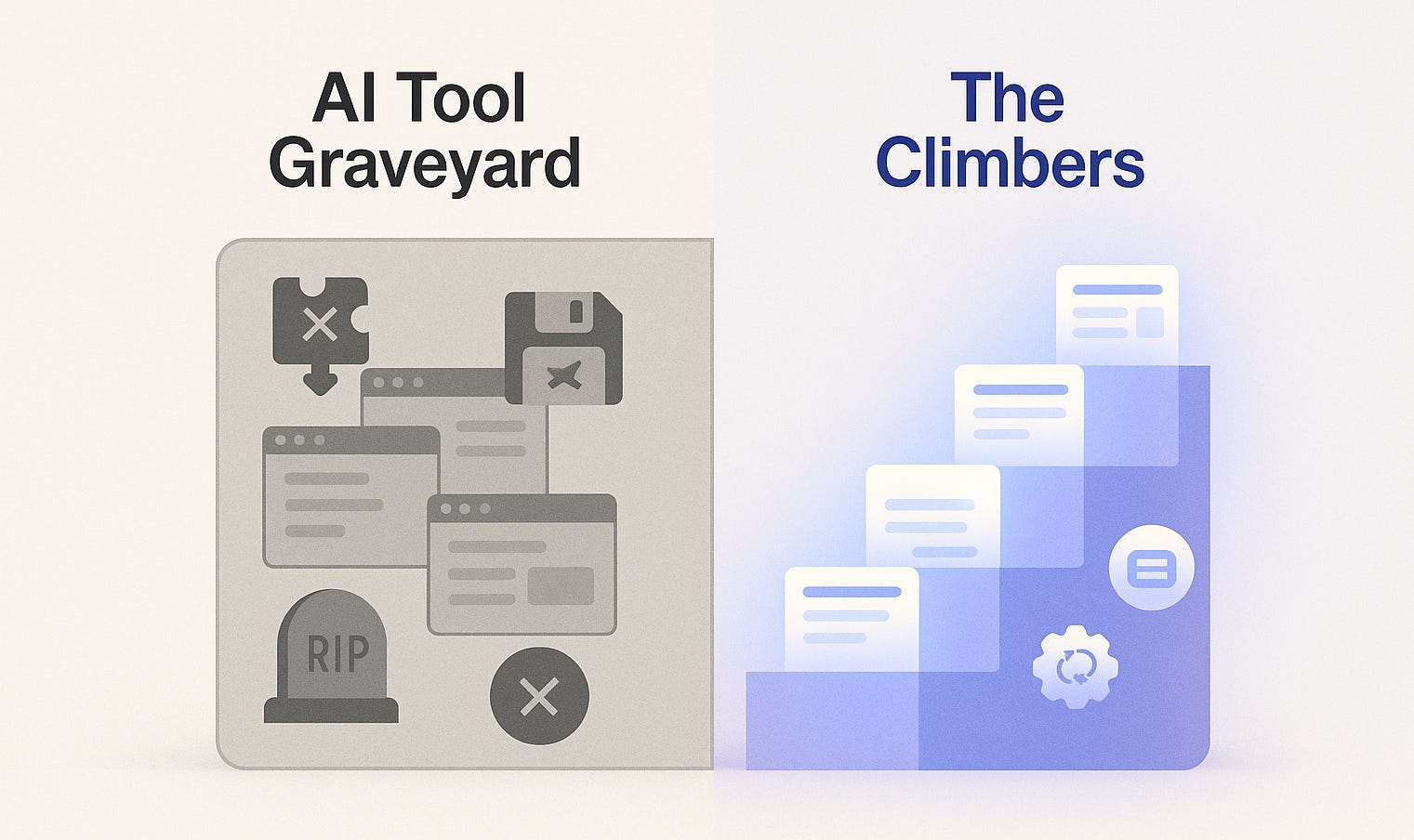
Most tools die here. They solve trivial problems with no memory, no depth, and no differentiation.
Level 2: Workflow Automators
What it is: Tools that stitch tasks together: email drafting, scheduling, formatting, exporting, etc.
Why it’s better: Adds convenience and time saving. Often integrated into existing tools.
Why it’s still not enough: Still generic. Still replaceable. Users don’t form habits.
Examples: AI Notion templates, Zapier with LLMs, Gmail AI integrations.
Level 3: Domain Specific Intelligence
What it is: AI tailored to a niche: law, medicine, SEO, design, finance, etc.
Why it stands out: Language, tone, and logic are adapted to expert use cases.
Why it’s sticky: Helps users make better decisions, not just faster ones.
Examples: Harvey (law), Glass Health (medicine), Derivate X’s LLM SEO tools.
Level 4: Context Aware Ecosystems
What it is: Tools that remember, learn, and operate across sessions and systems.
Why it’s powerful: Feels like an assistant, not a toy. Leverages APIs, databases, user inputs.
Why it’s rare: Requires infra, personalization, and smart architecture.
Examples: Personal AI agents, AI CRMs, memory powered copilots.
Level 5: Knowledge Engines & Distribution Layers
What it is: Tools that own attention, aggregate data, and shape demand.
Why it dominates: Becomes the default interface. Powers ecosystems, not just features.
Examples: ChatGPT, Perplexity, Arc Search, Sourcegraph Cody, and AI powered vertical search platforms.
These tools don’t just use information. They become the layer through which others access it.
Where Do You Fit? (A Self Audit Framework)
Now that you’ve seen the hierarchy, ask yourself:
Where is your tool (or idea) actually playing?
And are you okay staying there?
Because here’s the truth: Most builders think they’re building at Level 3 or 4.
In reality, they’re stuck at Level 1 with a prettier UI.
Let’s simplify your self assessment with 3 brutally honest questions:
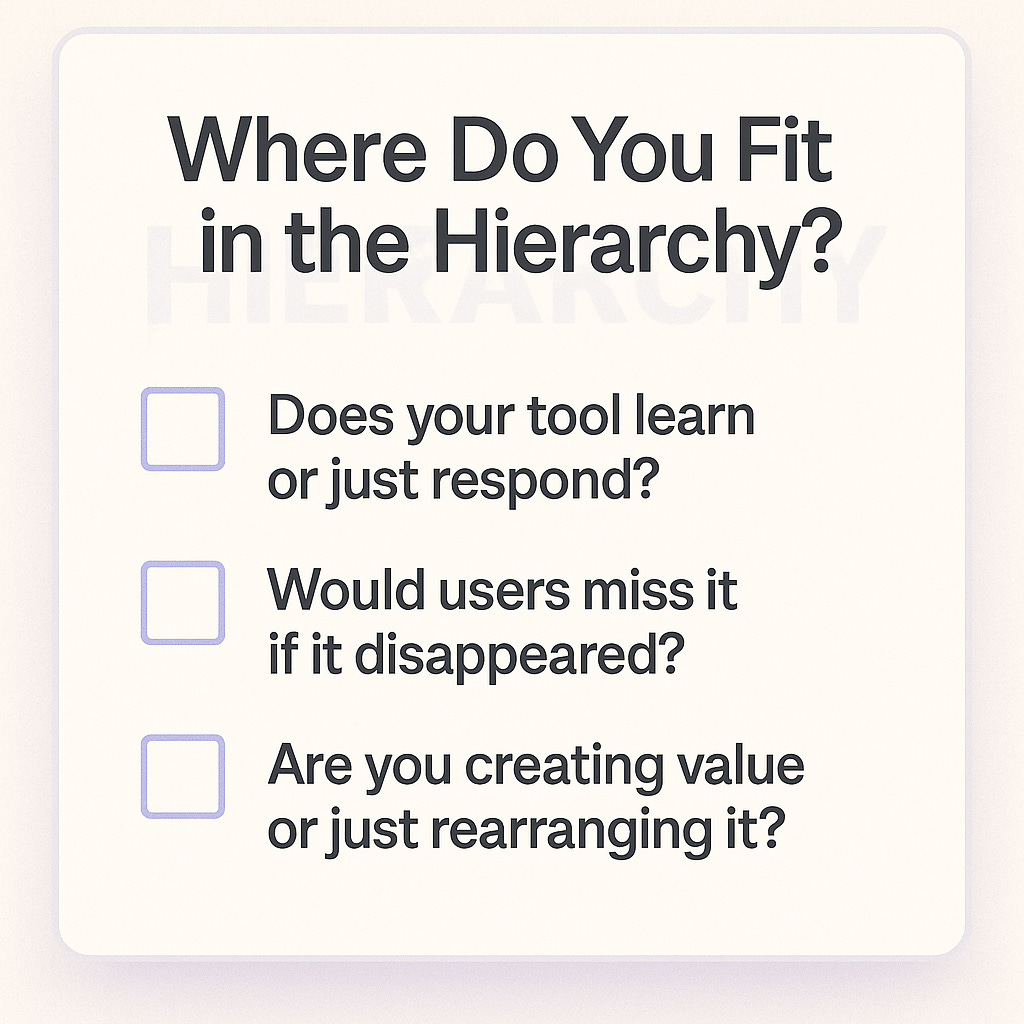
1. Does your tool learn or just respond?
If every user gets the same output, you’re replaceable.
Context, memory, and feedback loops are what separate a tool from a product.
If your tool forgets everything between sessions, you’re below Level 4.
2. Would users miss your tool if it disappeared?
Not in theory. In practice.
If users can just jump to another GPT wrapper and get 90% of the value, your tool is deadweight.
Level 3 and above is where emotional and functional dependency begins.
3. Are you creating value or just rearranging it?
Are you generating new knowledge, insights, or data signals?
Or just shuffling around what the model already knows?
Level 5 tools don’t just surface data, they become the source of truth.
How to Move Up the Ladder
If you’re building:
From scratch: Start at Level 3. Niches are defensible.
At Level 1 or 2: Inject context. Add memory, personalization, workflows.
Above Level 3: Start owning inputs. Aggregate data, control interfaces, build distribution.
Remember, power in AI doesn’t come from being new. It comes from being needed.
Why This Matters Now
We’re entering the compression phase of the AI cycle.
What used to feel like opportunity (endless tools, novelty, growth hacks) is now a race to the bottom.
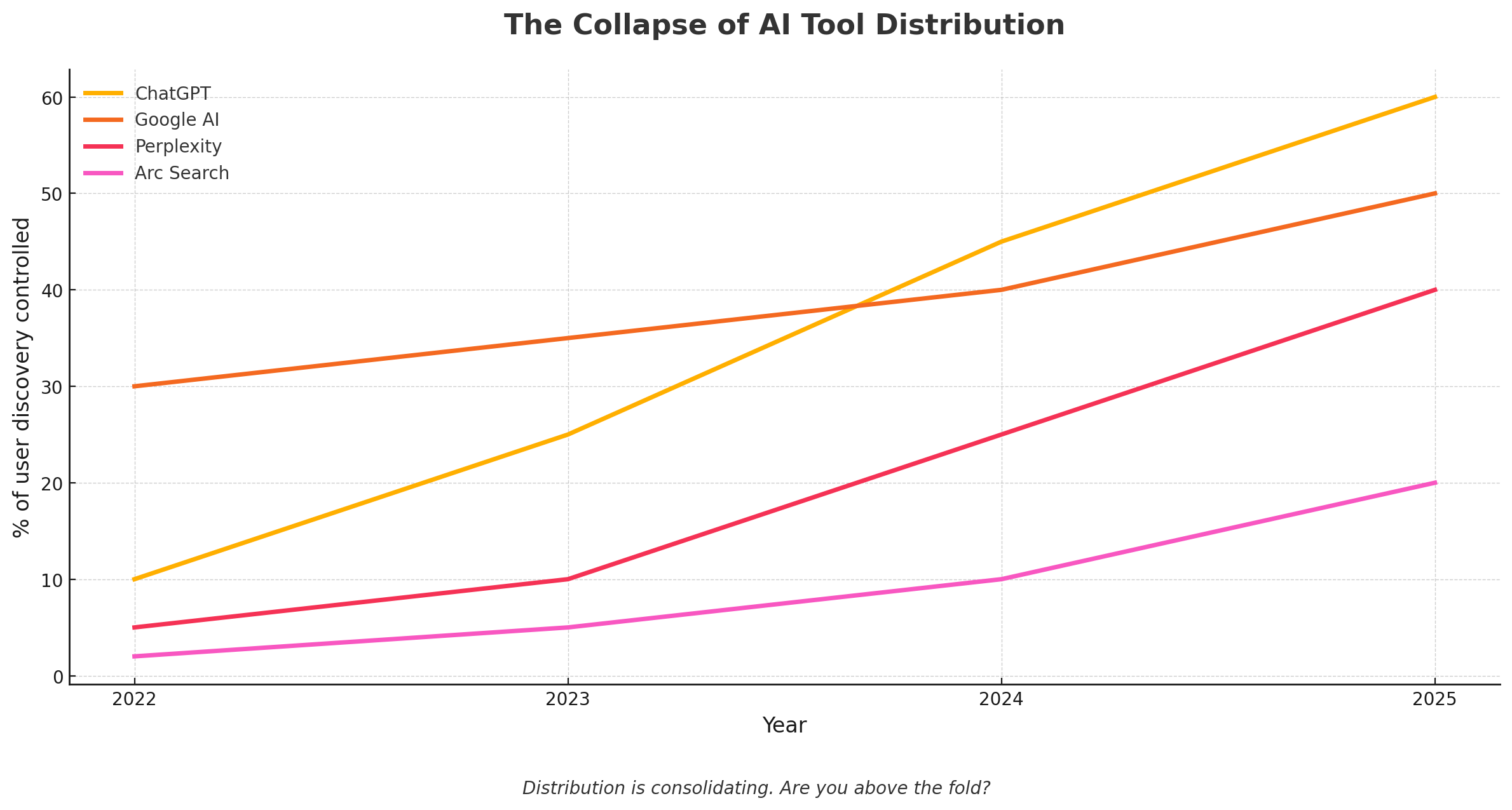
Here’s what’s happening:
OpenAI is building an OS. With GPTs, memory, and multi modality baked in, OpenAI is no longer just a model provider. It’s becoming the interface.
GPT-5 is on the horizon. Meaning anything built on top without added value will get flattened.
Users are overwhelmed. Thousands of tools, zero standards, and every product sounds the same.
Distribution is centralizing. Google, ChatGPT, Perplexity, Arc — they’re all becoming gatekeepers of discovery.
So what survives?
Depth. Context. And distribution of your own.
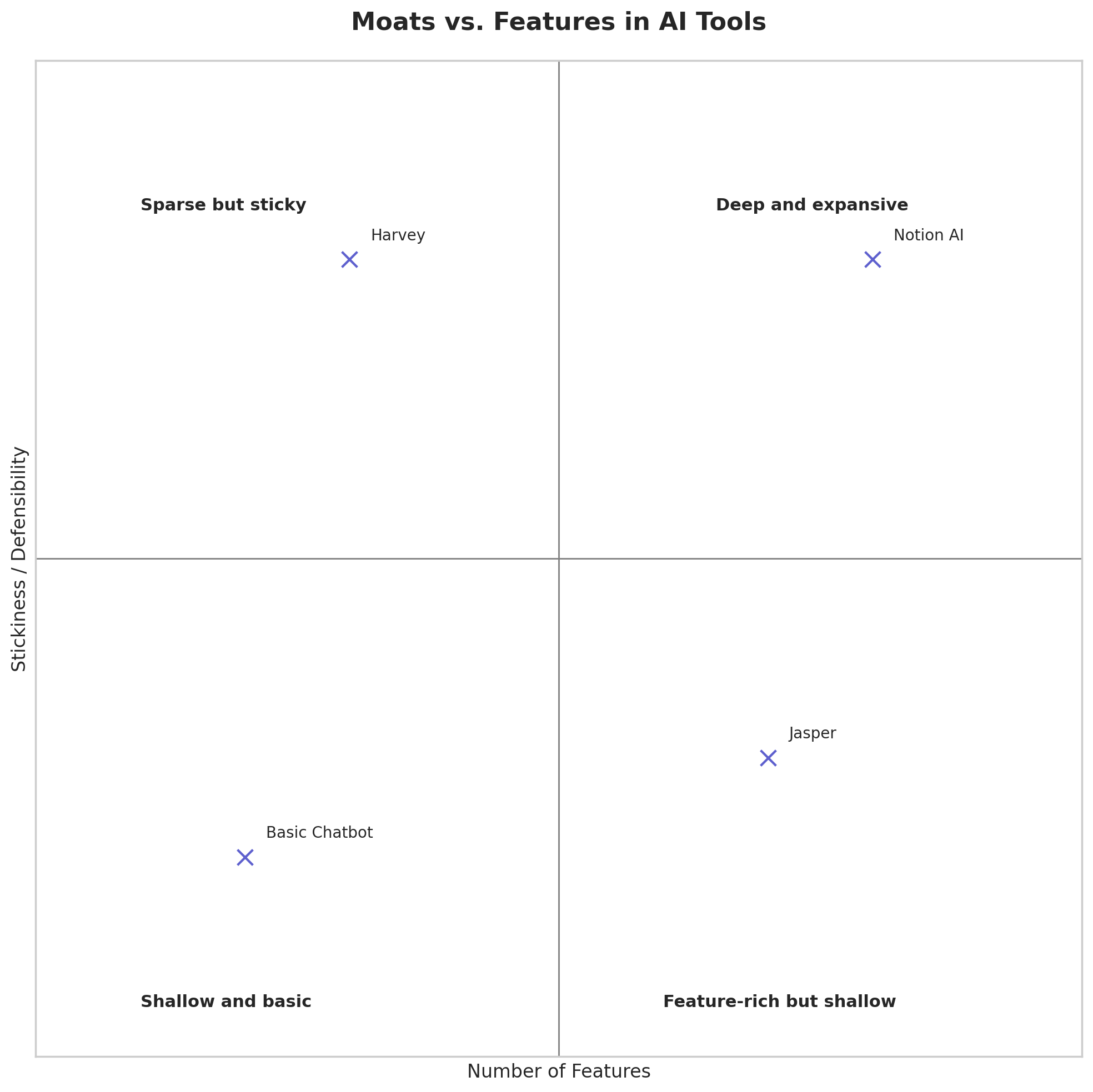
The Real Moat in AI Is Information Positioning
Not just what your tool does.
But where it sits in the user’s information journey:
Are you the source?
Are you the processor?
Are you the interface?
Are you the index?
Tools that own even one of these layers, and integrate context deeply, win by default.
Everything else gets crowded out, cloned, or commoditized.
How Found on AI Will Use This Hierarchy
This hierarchy isn’t just a thinking tool.
It’s now the lens we’ll use to curate everything in Found on AI.
Because let’s face it, most AI roundups are junk drawers.
10 tools doing the same thing.
Zero signal on what’s actually worth using.
No clarity on how these tools fit into real workflows.
We’re changing that.
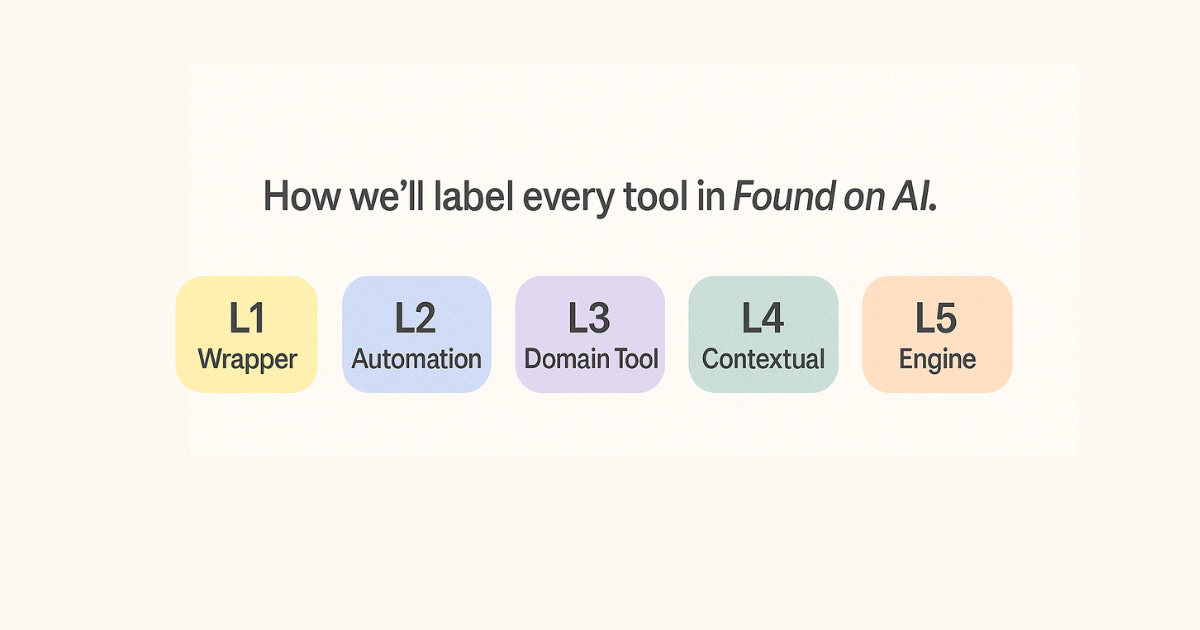
From Now On:
When we feature a tool, we’ll tag it by hierarchy level.
You’ll know whether it’s:
A shiny wrapper (L1)
A time-saver (L2)
A niche powerhouse (L3)
A contextual assistant (L4)
Or a foundational knowledge engine (L5)
You’ll stop scrolling through noise. And start seeing patterns.
Why This Helps You
Whether you’re:
A founder looking to build
A PM tracking trends
A user seeking real productivity
Or an investor scanning for edge
You’ll instantly know where a tool stands, and whether it’s worth your time.
In other words: we won’t just show you tools.
We’ll show you how to think about them.
Got a Tool? Send it In.
If you’re building something or love using something that deserves a spot in this pyramid, tell us. We’ll feature the best ones in upcoming issues.
Note: We value originality, context, and actual user value. Not wrappers.
Final Takeaway
In the gold rush of AI, everyone’s building. But very few are thinking in layers.
Most tools are wrappers.
Some tools are assistants.
A rare few become interfaces for how we consume, create, and interact with information.
The difference isn’t in what you build. It’s in where it lives in the hierarchy.
So the next time you see a new AI tool (or ship your own), ask:
Is this solving a surface problem… or embedding itself into how people think?
Because in a world where models are open and features are free, the real product is context.
And the real edge is where you sit in the information stack.
If this gave you a new lens on how to build, invest, or choose AI tools, share it with someone who’s lost in the noise.
And if you’re not already subscribed:
→ Get “Found on AI” delivered weekly.
Curated tools. Sharp frameworks. No bullshit.